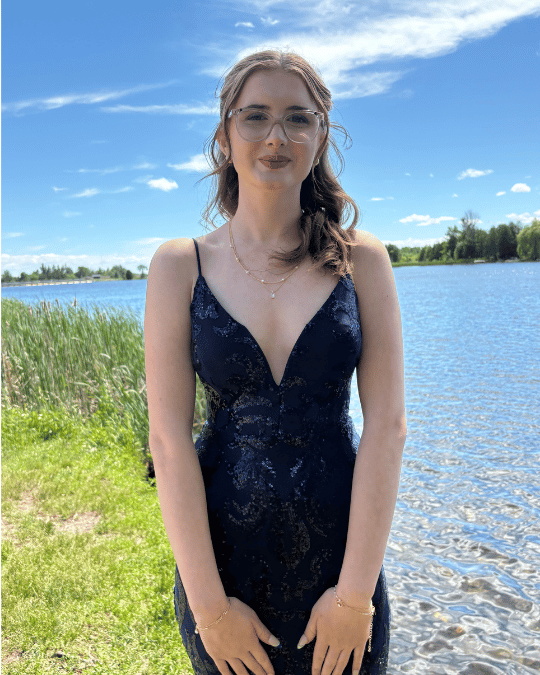
 When she was growing up, Kara Doherty’s experiences with the Canadian medical system showed her the good, the bad, and the intimidating. Kara was born with a conductive hearing loss. She was diagnosed at only a few years old. Over the years, she encountered many types of appointments to help her navigate a hearing world. As she grew up, she experienced firsthand the varied approaches of different carers.
Kara appreciated those who knelt to her level to communicate, who made sure she could read their lips, and who spoke to her directly and patiently. Some people she interacted with became role models.
“When I younger, I wrote a speech about hearing loss. I was so happy and excited to show it to my audiologist at the time, and her taking time to listen. Others asked about school or my interests, making my many appointments more enjoyable” she says. “Other medical professionals were on a timeline, and seemed concerned with me only as a patient rather than a person. I noticed the difference.”
With support from Empowered Kids Ontario, Kara started a pre-health program at Loyalist College and plans to go into nursing. She views it as a privilege to pursue a career that will allow her to give back to others what the best of her own support network gave to her: universal respect for people’s humanity.
“No matter what differences someone has, if they're a good person, they're a good person,” she says. “I've seen the difficulties people go through and how that can change who they are, for both good and bad. I understand what it's like to be in that position.”
In grade eleven, Kara participated in a co-op placement caring for people with dementia. Those she met felt scared and isolated. Where some teenagers might have found this daunting, Kara felt empowered by the role she could play in alleviating their difficulties. This experience had a profound, lasting effect on her.
“All they wanted was someone to be with, which is quite sad in a way,” she says. “I feel like being in a position where I'd be able to help them every day would be amazing.”
She is now planning to specialize in palliative and dementia care, an area she says is “among the most critical and most overlooked in all of healthcare.” She made this choice for both personal and professional reasons. She knows that a career in nursing offers her stability and the ability to support herself financially, while contributing to her community. She calls it “building a future with intention,” and knows that she’ll bring to the job her own “intimate understanding of vulnerability.”
“The parallels between my own experience and the experiences of those living with other challenges are not lost on me,” she says. “Stigma, silence, and the fear of being reduced to a label rather than seen as a whole person: these are barriers I understand deeply.”
She says being awarded an EKO scholarship feels like a kind of breaking of barriers.
“A lot of people tend to judge people negatively and quickly based on their differences, which isn't fair,” she says. “This award shows society that differences and individual hurdles don't limit a person, but rather they can use their experiences to serve others. I think it shows that your differences don't have to stand in the way of who you are and who you want to be.”
Back to our 2026 EKO Scholars