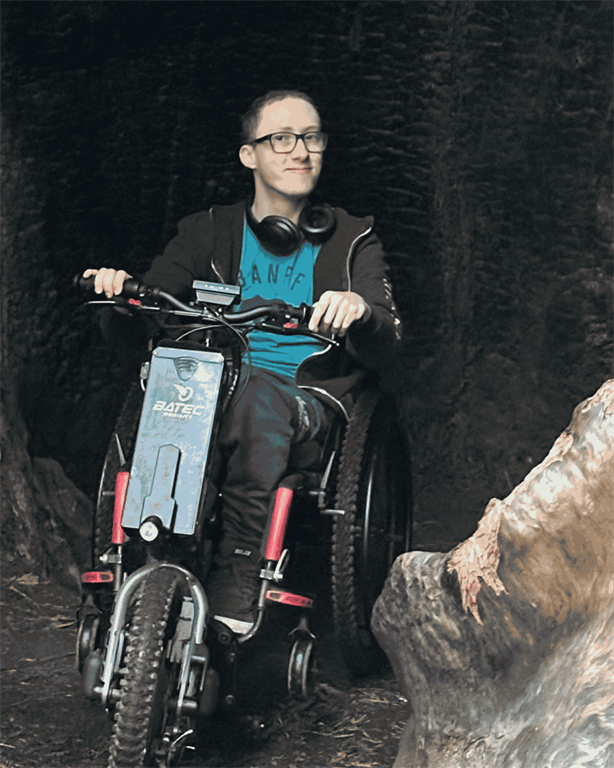
 Hayden Tange just joined Trent University’s Journalism and Creative Writing program, and he has plenty of stories to tell. He also has many stories he’s already told: Tange has already distinguished himself as a writer, YouTuber, and two-time Language Arts Award winner at his Oakville high school.
“I have a learning disability that means subjects like math are not really my strong suit,” he says. “On the other hand, I excel very much in areas like creative writing and journalism. That's much more my speed.”
Hayden grew up living with ADHD and anxiety. He also is affected by spina bifida and a condition called hydrocephalus, which results in fluid building up around the brain and creating pressure on the skull. Hayden’s fascination with the world and his enthusiasm for narrative swamped his aversion to crowds and loud noises, as well as his mobility needs. The YouTube videos he writes and produces chronicle, among other things, a months-long road trip, during which he and his family crisscrossed North America, visiting national parks, camping, and spotting wildlife.
“Part of what writing gives me is opportunities,” he says. “You can basically write about anything if you have a creative mindset. If you have the creative ability to do it, you can just do all this crazy stuff.”
Hayden’s interests as a communicator extend well beyond travelogues. He has never driven a car but has piloted a plane and assisted an engineer in driving a train. Whether it’s an appreciation of natural beauty in the world today, or a fascination with long-extinct dinosaurs, Hayden turns his adventures into stories, and experiences into self-knowledge.
“I’ve learned a lot, over the last half year, about independence, about the different ways I have to adapt. I’m quite a bit different from a regular person. If there’s something I need to learn to be independent, doing it the way someone else would won’t work for me. I have to find a way to modify or adapt it,” he says. “Some people might think that the fact that I’m disabled means that everything is way more difficult for me than for an able-bodied person. That’s sometimes true. But some things might be not be as challenging as you might expect.”
Winning an EKO scholarship, he says, does a lot of good in making the next chapter of his story less challenging.
“It is a financial boost, obviously,” he says. “Having this extra money coming in is going to make it a lot easier in terms of not going bankrupt on day one. It’s also going to make it easier to handle everything outside of finances: school will be a lot easier if I don’t have to worry as much about my financial situation. I can focus on taking care of myself, and my studies.”
While many young people view the future with trepidation, Hayden is already thinking about the opportunities that await him after he graduates.
“This is a broad postsecondary program where I’ll experience a lot of different things. Once I’m done, I’m probably going to have quite different career opportunities. I still need to think about what I want to do.”
Back to our 2026 EKO Scholars